|
Lot No.385
AUC09
Ancient India
Auction Date: 18-08-2012
Gold
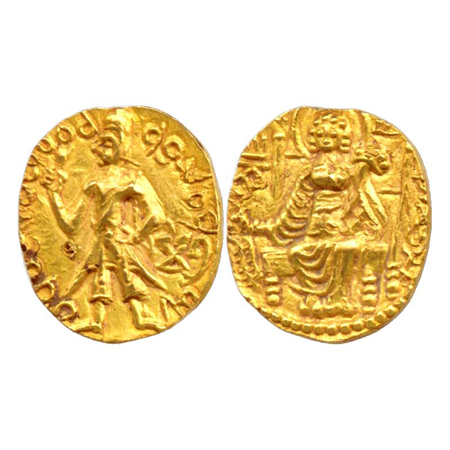
Kushan-style gold coinage of Gangetic valley (Allahabad – Varanasi) region, dinar with inscription 'Mishra'/ 'Migra', c. 250-300AD, 7.75g. Obv: A Kushan-style depiction of a standing king, but he holds a flower / mace aloft in his right hand while resting the left hand on a dagger hanging by his waist. Brahmi letters 'Mi shra' / 'Ma gra' next to the elbow and blundered Bactrian legend around. Rev: Goddess 'Ardochsho' seated on throne holding a cornucopia, tamgha in the left field.
Extremely Fine of the Great Rarity.
It is not certain who struck this extremely rare type of gold Dinara, but its type suggests it must have been struck in the period between the Kushans and the Guptas. The most likely contenders are the Magha dynasty who rose to prominence in the area around Kaushambi in the 3rd century AD. Goebl has listed similar coins as type no. 578, but the coin offered here bears many differences with what Goebl illustrates - the most noteworthy being the details of the obverse depiction of a standing king. The king shown here does not have a trident with ribbons next to him nor a chakra behind him, and his posture is very different then the standard 'Kushan' posture seen on Goebl's coins where he is shown offering a sacrifice with one hand while holding the other hand upright. Also, the legend next to the arm more clearly begins with a 'Mi' and there is no trace of a letter under the king's arm, whereas there is a 'Ga' at the same position on all the coins Goebl illustrates. All these factors indicate that this coin presents an 'evolved' typology than Goebl's coins and as such it may have been issued slightly later than those listed by Goebl. Only 2/3 examples of this type were seen in the past years.
View Lot
Estimated Price :
Rs. 3,50,000-4,00,000
|