|
Lot No.81
AUC31
Hindu Coins of Medieval India
Auction Date: 11-08-2018
Gold
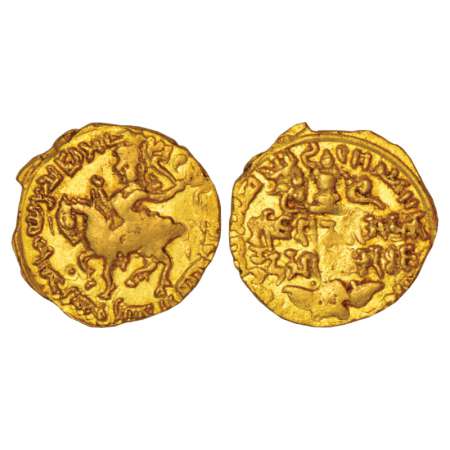
Rashtrakutas, gold Dinara of Govinda III (793-814 AD), also known as 'Prabhutavarsha Pratapavaloka Jagattunga', unpublished, 4.18g. Obv: king mounted on a horse, riding to left, with a curved sword held in raised hand; pseudo- Arabic inscription around. Rev: as on obverse, pseudo- Arabic inscription along the margins; in centre, two line inscription in proto Nagari/ Kutila script - Shri JagatungaAprati / hataShataGarudadhwaja Above the inscription, a row of Vaishnavite and auspicious symbols (lotus, Kalasha and Sankha) and below the inscription, a half lotus pedestal supporting the legend.
Extremely fine, Exceptionally rare.
Jagatunga' or 'Tallest (by fame/valour) in the World was a title held by more than one Rashtrakuta rulers. However, Govinda III appears to be the best fit for the purpose of attributing this coin. He was an illustrious king, credited with many victories, including those against the Pratiharas of Kannauj, the Palas of Bengal, the Eastern Chalukyas of Vengi and the Pallavas of Kanchi. The title 'Apratihata' or 'invincible’ applied to him in the coin legend is therefore a very fitting acknowledgement of his triumphs.
Another significant characteristic of the coin is the pseudo- Arabic inscriptions on both sides. It is a well-known fact that the Rashtrakutas were friendly with the Islamic Caliphate of Baghdad. The backbone of their friendship was a thriving trade in horses carried out from ports on the Western Coast of India, which was under Rashtrakuta control. These horses proved crucial in the campaigns which the Rashtrakutas conducted against other ruling powers. There were even Arab colonies on the Western Coast and some Arabs had also entered Rashtrakuta service, as we know from copperplate inscriptions. Conceivably, many Arab gold coins must have arrived through the trade into India and they appear to have provided the design inspiration for Rashtrakuta gold coins.
The reign of Govinda III fits well with the heyday of this trade and the fact that he chooses to show him as a horse rider also befits the nexus established between the Arabs and the Rashtrakutas through commercial activities. The mention of 'Garuda-dhwaja' or 'Ensign of the Garuda' in the legend refers to the dynastic emblem of the Rashtrakutas, who were Vaishnavites and employed Garuda the bearer of Vishnu to show their devotion to their patron deity.
View Lot
Estimated Price :
Rs. 12,00,000-15,00,000
Sold For :
Rs. 12,00,000
|