|
Lot No.66
AUC23
Ancient India
Auction Date: 11-12-2015
Gold
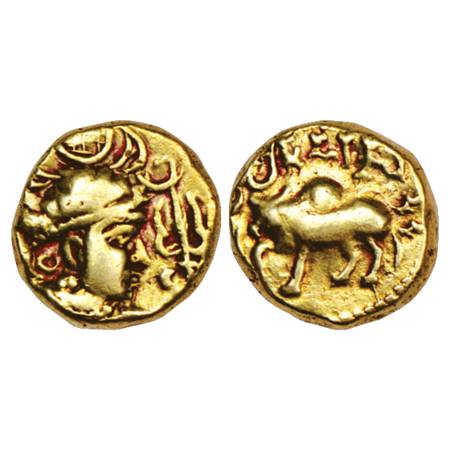
White Huns or Hephthalites in India, Mihirakula (515-535 AD), Gold Dinar, 7.07g. Obv: Bust of king facing right, wearing elaborate Sasanian style headdress, with diadem ties and the back, solar disc at the apex and crescent moon on the forehead; Shaiva-Saura emblem of Trident-Vajradanda with pennants attached at the hilt. Rev: Humped bull walking to left, ceremonial ribbons tied to hump fluttering above its tail; Brahmi legend ...Shri Mihirakula above.
About Extremely Fine, Unpublished and unique so far and Great Rarity of a highest historical importance.
This is one of the first gold coin of the Hunas in India to have come to light. Its obverse is typologically derived from the coins of Sassanian Emperor Peroz (459-484AD) who was a close predecessor of the Huna hegemony in India. The reverse bears a majestic bull with a Brahmi inscription above it. There are traces of some letters, most apparently a matra of 'U' to the left of the extant inscription. Most likely, the word here must be Jayatu thus making the full legend read Jayatu Shri Mihirakula. The symbolism of both the obverse and reverse is closely comparable with the known silver and copper issues of Mihirakula with a strong emphasis on Shaivism. The legend is also comparable to that on a variety of silver drachms of Mihirakula. Mihirakula was a powerful ruler and under his brief rule the Huna hegemony reached its apogee in mainland India. He was a devout Shaiva as recorded in his inscription at Gwalior. At the zenith of his rule the Huna Empire reportedly covered North India from Kausambi to Northern Gujarat and from Punjab to Malwa. The Hunas were famously defeated by Aulikara king Yashodharman and the Gupta ruler Narasimha Gupta Baladitya. After his defeat, Mihirakula is known to have retreated into Kashmir, where he staged a coup and created trouble for a few years before passing into historical oblivion. This coin is significant from a number of perspectives. Its type and denomination suggests strong connections to the regions of South Punjab - Northern Sindh, where similar Sasanian-inspired gold coins had already been in circulation. This connection is important because till now there was no clear numismatic link available to suggest the advent of the Hunas into Rajasthan and Malwa. This coin proves that the Hunas were present not only in North and East of the Indus-Ganges Divide, but also to its immediate West, adjoining Rajasthan. Its type and symbolism adds further weight to the religious and social connection of late Gupta period India to the wider Iranian world in terms of religious influence as it shows Solar symbolism of the obverse merging with the Shaiva symbolism of the reverse. The bull depicted is without a doubt a Shaiva bull, but with the ceremonial ribbons attached to it, it is also a sacrificial bull, let free to roam at will with a Brahmanic ritual such as Wrushotsarga. Its large hump signifies virility and masculinity, qualities which indirectly also allude to its issuer.
View Lot
Estimated Price :
Rs. 8,00,000-10,00,000
Sold For :
Rs. 9,00,000
|