|
Lot No.125
AUC15
Mughals
Auction Date: 02-02-2014
Gold
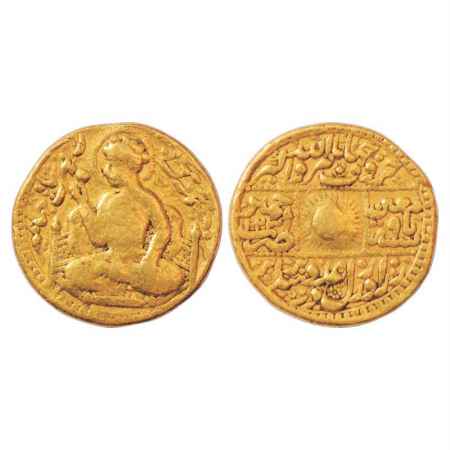
Jahangir (1605-1627 AD), Gold 'Portrait' Mohur of Ajmer Mint, AH 1023/RY 9, 10.81g. KM 179.6 (possibly ex-mount). Obv: Nimbate portrait of Jahangir seated cross-legged, reclining against a bolster on a hexagonal throne, holding a gobletlike ornament in his hand; Farsi couplet around – Qiza bar Sikka-i-Zar Kard Tasweer Shabeeh-i-Hazrat Shah Jahangir (Destiny has made the picture of the likeness of venerable king Jahangir on this gold coin) Rev: a sun-burst emblem in centre with compartments on either side – one of left has Farsi inscription Zarb Ajmer 1023 and on the right Ya Mu'een Sanah 9; Farsi couplet in margins above and below Huroof Jahangir wa Allahu Akbar Za Roz-i-Azal dar 'Adood Shud Barabar
About Very Fine, Exceedingly Rare.
(The words 'Jahangir' and 'Allahu Akbar' are equal in value till the Day of Judgement) One of the most interesting of Jahangir's coins were his portrait issues which by his own admission were given to his acolytes as a special gift which they can 'wear on their turbans or sashes' to show that they had been graced by Imperial favour. During 1615-1619, Jahangir moved his court to Ajmer for three years and this coin was struck in that period. The portrait on obverse shows Jahangir holding up a goblet – described by many numismatists to be a wine goblet, thus showing the Emperor in fond attachment to his favourite affliction, yet a total heretic in view of the tenets of Islam. The legend surrounding him mentions 'fate' or 'destiny' which is a strong indication of the king's belief in fatalism and the might of 'destiny' in shaping the kingly fortune. On 26thAban of his RY9, he makes an entry in his diary that upon entering the city of Ajmer a mystic came unto him and informed him that words 'Jahangir' and the 'Supreme Name' or Ism-i-'Azam ('Allahu Akbar') add up to the same total according to the tenets of the 'Abjad' system, which applies numerical value to each letter in the alphabet. “Considering this a good omen”, Jahangir writes, “I gave the discoverer of this coincidence land, a horse, cash and clothing”. Exactly the same sentiment of equivalence is invoked in the couplet on the reverse. On 9thAmardad of the same year, Jahangir describes a strange illness that overtook him and made him beseech the intervention of Khwaja Mu'eenuddin Chishti, the patron saint lying at rest in Ajmer, to cure him. The prayers worked and when recovered, Jahangir's veneration for the Sufi saint grew tremendously. In proclaiming his servitude to the Khwaja, he publicly got his ears pierced and held the ceremony of his weighment against precious metals which were then distributed in charity. The invocation Ya Mu'een seen on the reverse of the coin suggests a close connection between the issue of these coins and this event. In all likelihood the coins were struck soon after this episode when the Emperor held his court after his recovery. This would also explain the reference to 'destiny' in the verse on obverse.
View Lot
Estimated Price :
Rs. 15,00,000-20,00,000
Sold For :
Rs. 45,00,000
|