|
Lot No.36
AUC11
Ancient India
Auction Date: 15-03-2013
Gold
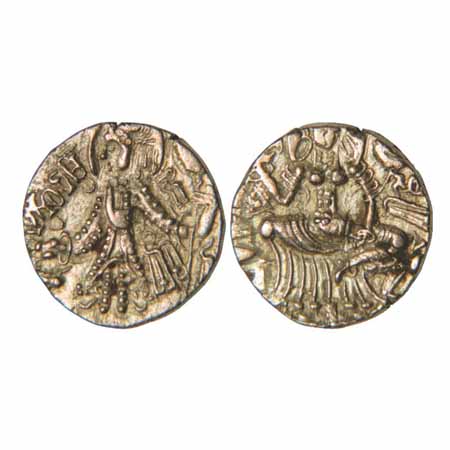
Kushan-Derivative Coinage, 7.19g. Base Gold stater of Tunjina, King of Kashmir (there are three recorded kings with this name in the Kashmir Chronicle, Rajatarangini). The most likely of the kings with this name to have issued this coin is Tunjina I, ruling in the seventh century AD. The obverse shows the Hindu god Shiva, with a halo round his head, standing facing left holding a trident in his left hand and making an offering on a small altar with his right. The Sanskrit inscription on the obverse is written before the king's face, anticlockwise to be read from edge of coin Shri Tuysina. The design is copied from a Kushan gold coin, which shows the Kushan king, dressed in an overcoat in the same posture. The reverse shows Parvati, the spouse of Shiva in the guise of Shri, goddess of good fortune, with a halo around her head. She is seated facing on a low throne, holding a lotus in her left hand resting on her thigh, and another in her raised right hand. She wears large earrings, a necklace, a skirt (draped over the throne) and scarf over her shoulders and round her arms. The Sanskrit inscription is in two parts: Kidara, in the left field (off the flan on this example) and Jaya in the right field.
Extremely Fine,Exceedingly Rare.
An example was first published by Sir Alexander Cunningham in 1894, in his Coins of Medieval India, plate III, no. 1 and p. 42, where he misread the inscription and misattributed the coin to Toramana the sixth century Hun king.
View Lot
Estimated Price :
Rs. 3,50,000-4,00,000
|