|
Lot No.140
AUC53
Ancient World
Silver
Kingdom of Macedonia, silver tetradrachm of Alexander III the Great (336-323 BC), Babylon series, 16.65g. Obv: Head of young Heracles in a lion's scalp facing right. Rev: Zeus with a long scepter and an eagle on his outstretched right hand, seated on a throne, letter M in the left field, a monogram below the throne, on the right Greek legend ΑΛΕΞΑΝΔΡΟΥ fully visible. Cabinet toned, Well-centered with dotted border visible on both sides, Minor deposits.
About extremely fine, Very rare.
** You can enter any bid amount more than or equal to the Next Bid **
|
|
Lot No.141
AUC53
Ancient World
Silver
Greeks Principalities in Bactria - silver hemidrachm of Sophytes (c.305-294 BC), SNG ANS 25, 1.42g. Obv: Male head right, wearing crested Attic helmet decorated with a laurel wreath on the bowl and a wing on the cheek guard. Rev: Cockerel standing facing right, kerykeion (staff of Hermes) above; Greek legend SOPhYTOU to right.
Good very fine, Rare.
According to some scholars, Sophytes was a Greek prince, who ruled Bactria before the invasion of Alexander and was allowed to retain his kingdom as a Satrap by the Macedonian king. His identity is enigmatic however he is credited with issuing a well organised coinage, first imitating civic coins of Athens and then striking 'cockerel'-type coins in his own name.
** You can enter any bid amount more than or equal to the Next Bid **
|
|
Lot No.142
AUC53
Ancient World
Gold
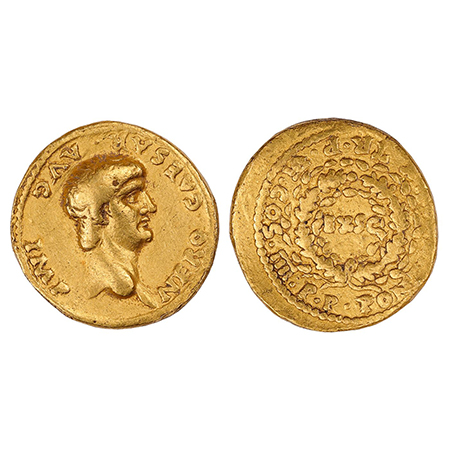
Roman Empire, gold aureus of Nero (54-68 AD), Lugdunum mint, Calico 426, 7.44g. Obv: Bare head facing right, Legend NERO. CAESAR. AVG. IMP counterclockwise. Rev: Legend EXSC within a wreath of two laurel branches, legend PONTIF. MAX. TR. P. VI. COS. IIII. P. P. around.
An attractive specimen with a portrait struck in high relief, Good very fine, Extremely rare.
When Nero succeeded Claudius in AD 54 at just sixteen years of age, few could have foreseen the notoriety that would come to define his reign. During its opening years, however, the young emperor governed under the guidance of the philosopher Seneca and the praetorian prefect Burrus, presiding over a period of relative stability and effective administration. Ancient authors, including Tacitus, regarded these early years as the most successful of Nero's principate before his increasingly autocratic character began to emerge. Struck in AD 60, this aureus belongs to that comparatively tranquil phase of Nero's reign, before the Great Fire of Rome, the executions of his mother Agrippina and wife Octavia, and the growing unrest that would ultimately bring about his downfall. Its youthful portrait serves as a reminder of an emperor whose promising beginnings stand in striking contrast to the tyranny for which he is chiefly remembered.
** You can enter any bid amount more than or equal to the Next Bid **
|