|
Current Auction Item 
|
|
|
|
|
|
|
|
|
|
|
Lot No.99
AUC52
Hindu Coins of Medieval India
Gold
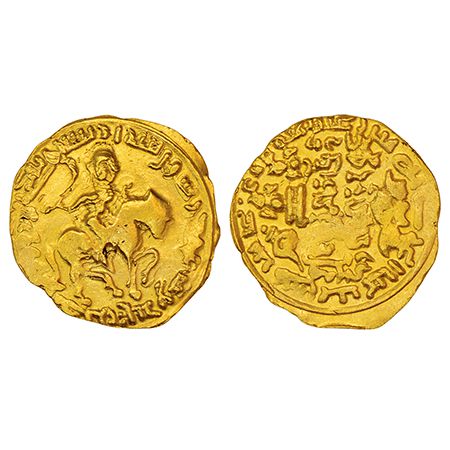
Rashtrakutas, gold dinara of Govinda III (793-814 AD), also known as 'Prabhutavarsha Pratapavaloka Jagattunga', unpublished in major sources, 4.18g. Obv: King riding a horse, facing right, with a curved sword held in raised hand; pseudo-Arabic inscription around. Rev: As on obverse, pseudo-Arabic inscription along the margins; in centre, two line inscription in proto Nagari/ Kutila script - Shri JagatungaAprati / hataShataGarudadhwaja Above the inscription, a row of Vaishnavite and auspicious symbols (lotus, Kalasha and Sankha) and below the inscription, a half lotus pedestal supporting the legend.
Extremely fine, Exceedingly rare.
The legend on the coin means the glorious and unconquered King Jagatunga. 'Jagatunga' ("Tallest [by fame/valour] in the World") was a title borne by the Rashtrakuta rulers. Govinda III appears to be the best fit for the attribution of this coin. He was an illustrious king, credited with many victories, including those against the Pratiharas of Kannauj, the Palas of Bengal, the Eastern Chalukyas of Vengi and the Pallavas of Kanchi. The title 'Apratihata' or 'invincible' applied to him in the coin legend is therefore a very fitting acknowledgement of his triumphs. Another significant characteristic of the coin is the pseudo- Arabic inscriptions on both sides. It is a well-known fact that the Rashtrakutas were friendly with the Islamic Caliphate of Baghdad. The backbone of their friendship was a thriving trade in horses carried out from ports on the Western Coast of India, which was under Rashtrakuta control. These horses proved crucial in the campaigns which the Rashtrakutas conducted against other ruling powers. There were even Arab colonies on the Western Coast and some Arabs had also entered Rashtrakuta service, as we know from copperplate inscriptions. Conceivably, many Arab gold coins must have arrived through the trade into India and they appear to have provided the design inspiration for Rashtrakuta gold coins.
The reign of Govinda III fits well with the heyday of this trade and the fact that he chooses to 'show him as a horse rider also befits the nexus established between the Arabs and the Rashtrakutas through commercial activities. The mention of 'Garuda-dhwaja' or 'Ensign of the Garuda' in the legend refers to the dynastic emblem of the Rashtrakutas, who were Vaishnavites and employed Garuda the bearer of Vishnu to show their devotion to their patron deity.
** You can enter any bid amount more than or equal to the Next Bid **
|
|
Lot No.100
AUC52
Hindu Coins of Medieval India
Silver
Gujarat Prathiaras, Bhoja I (836-885 AD), silver dramma, so called 'Adivaraha' (the boar incarnation of Vishnu), Deyell 8, 4.05g. Obv: Varaha facing to right, holding the earth on his tusks, conch and chakra below. Rev: Devanagari legend Srimadadi Varaha in two lines.
Good very fine, Very scarce.
** You can enter any bid amount more than or equal to the Next Bid **
|
|
Lot No.101
AUC52
Hindu Coins of Medieval India
Gold
Cholas (Ceylon), gold aka or fanam of Rajaraja I (985-1014 AD), MCSI-II 316, 0.49g. Obv: King standing facing right with one hand raised, holding globule above an altar. Rev: Devanagari legend Daraka with a conch-shell (Shankha) above, dotted border around.
Good very fine, Very scarce.
** You can enter any bid amount more than or equal to the Next Bid **
|
|
Lot No.102
AUC52
Hindu Coins of Medieval India
Gold
Cholas, gold 1/8 kahavanu of Rajaraja I (985-1014 AD) or Rajendra (1014-1044 AD), MCSI-II 330, 0.48g. Obv: Chola royal emblem of a bow, a seated tiger, a pair of fish, and an umbrella. Rev: Nagari legend in two lines Yuddha/Malla.
Extremely fine, Very scarce.
The title 'Yuddhamalla' was held by both Rajaraja as well as his son Rajendra.
** You can enter any bid amount more than or equal to the Next Bid **
|
|
Lot No.103
AUC52
Hindu Coins of Medieval India
Gold
Western Gangas (10th-11th century AD), gold gajapati ¼ fanam, 0.11g. Obv: An ornate elephant standing facing right. Rev: Ornamental floral scroll.
Extremely fine, Rare.
** You can enter any bid amount more than or equal to the Next Bid **
|
|
Lot No.104
AUC52
Hindu Coins of Medieval India
Gold
Western Gangas (10th-11th century AD), gold gajapati pagoda, MCSI-I 192-193, 3.74g. Obv: An ornate elephant standing facing right, there is a 3-layer pearl garland on the neck of the elephant, dotted floral motif to upper left. Rev: Ornamental floral scroll.
A beautiful example with sharp strike and radiant brilliance throughout, Extremely fine, Rare.
** You can enter any bid amount more than or equal to the Next Bid **
|
|
Lot No.105
AUC52
Hindu Coins of Medieval India
Gold
Nolambas of Nolambavadi, Nanni Nolamba I (969-975 AD), gold punch marked gadyana, repousse fabric, 3.78g. Obv: Nine punches - 5x Recumbent Nandi to left, 2x Kannada letter 'Shri', 1x Kannada legend 'Nani', 1x Kannada legend 'Nolamba'.
Uncirculated, Very rare.
** You can enter any bid amount more than or equal to the Next Bid **
|
|
Lot No.106
AUC52
Hindu Coins of Medieval India
Gold
Nolambas of South-Central Karnataka, Ekavakyadeva II (980-1000 AD), gold punch-marked gadyana, variant of SG Prabhu coin no. 17, 3.69g. Obv: nine punches: 5x Nandi seated facing right, sun and moon symbol above; 2x Kannada letters 'Shri', 1x Kannada legend ikaka and 1x symbol of 'Elephant Goad with battle axe'.
An alluring specimen with sharp strike and crisp details, Uncirculated with luster, Very rare.
** You can enter any bid amount more than or equal to the Next Bid **
|
|
Lot No.107
AUC52
Hindu Coins of Medieval India
Gold
Nolambas of South-Central Karnataka, Ekavakyadeva II (980-1000 AD), gold punch-marked gadyana, variant of SG Prabhu coin no. 17, 3.64g. Obv: nine punches: 5x Nandi seated facing right, sun and moon symbol above; 2x Kannada letters 'Shri', 1x Kannada legend ikaka and 1x symbol of 'Elephant Goad with battle axe'.
Uncirculated with luster, Very rare.
** You can enter any bid amount more than or equal to the Next Bid **
|
|
Lot No.108
AUC52
Hindu Coins of Medieval India
Gold
Feudatories of the Chalukyas of Kalyani, Andhra-Karnataka region, gold punch marked gadyana, (1100-1200 AD), 3.54g, with nine punches 5x Lion with raised forepaw facing right, 2x Kannada letter 'Sri', 1x Kannada legend 'Sithaga' and 1x Kannada legend 'Mavana'.
Uncirculated, Very rare.
** You can enter any bid amount more than or equal to the Next Bid **
|
|
Lot No.109
AUC52
Hindu Coins of Medieval India
Gold
Feudatories of Western Chalukyas, gold punch-marked gadyana of Jogava (c.11th century AD), 3.40g. Obv: five punches - 1x stylized seated Nandi in centre; 1x Shaivite sanctuary with Trisula, 1x Kannada legend Jagava and 2x Kannada letter Shri. Rev: the same 'seated Nandi' punch from obverse.
Extremely fine, Extremely rare.
An inscription at Rajuru in Ron taluka of Dharwad district, Karnataka, mentions Jagadekamalla ruling from his capital at Kalyanapura. It records that, while Prabhu Joga was administering Rajuru, an image of the god Jogesvara was installed and several gifts of land and money were made to the temples of Jogesvara, Gavaresvara and Somanatha. This record is dated 1033AD. It is plausible that 'Jagava' of this coin is the same as Prabhu Joga mentioned in this inscription.
** You can enter any bid amount more than or equal to the Next Bid **
|
|
Lot No.110
AUC52
Hindu Coins of Medieval India
Silver
Kadambas of Goa - anonymous silver tara, (c.1000-1100 AD), not listed in major publications, 0.17g. Obv: Roaring lion, facing left; crescent above. Rev: Kannada numeral 1.25.
Extremely fine, Rare.
The attribution of these coins to the Kadambas is based on their similarity with gold Gadyanas bearing the same 'roaring lion’ design.
** You can enter any bid amount more than or equal to the Next Bid **
|
|
Lot No.111
AUC52
Hindu Coins of Medieval India
Gold
Matsya kings of Oddadi (Chhattisgarh/Odisha) - uninscribed gold gadyana, (c.11th-12th century AD), unpublished so far, 4.20g. Obv: a small flower-like punch on an empty table applied on either side of the slit. Rev: Styrate marks.
Extremely fine, Extremely rare.
The Matsyas was an ancient dynasty of Mahakoshala region. They served as feudatories to Chalukyas of Kalyani and to the Chhindaka Nagas of Chakrakota (Bastar) at various times. The attribution of this unique kind of gadyana is based on the tentative find spot of the coins. They appear to be struck to two denominations of full and half gadyanas.
** You can enter any bid amount more than or equal to the Next Bid **
|
|
Lot No.112
AUC52
Hindu Coins of Medieval India
Gold
Kakatiyas of Warangal, gold punch-marked gadyana issued by a 'Lenka' (feudatory) chief, repousse fabric, (1100-1200 AD), 3.78g, Height: 27.42mm, Width: 27.55mm. Obv: Nine punches struck deeply on a thin flan - 5x boar facing left with sun and moon above, 2x Kannada letter 'Shri', 1x Kannada legend 'Koma' and 1x Kannada legend 'Lenka'.
Extremely fine, Rare.
The Kakatiyas emerged as independent rulers in late 12th century. Prior to this, they ruled as feudatories of the Chalukyas of Kalyana. But they also had feudatories of their own and these were known as 'Lenkas', literally meaning 'bodyguards'. It is certain that he was one of these feudatories. The fabric of the coin suggests an early date and most likely Koma Lenka ruled under Prola I (c.1052-1076 AD).
** You can enter any bid amount more than or equal to the Next Bid **
|
|
Lot No.113
AUC52
Hindu Coins of Medieval India
Gold
Kakatiyas of Warangal, Prola I (c.1052-1076 AD), gold punch-marked one-and-a-half Gadyana, 'The Four-armed deity' type, 5.75g. Height: 58.10mm, Width: 58.76mm. The obverse consists of 20 repousse punches elegantly and deeply struck in two concentric tiers on a broad thin flan. The central punch consists a frontal figure of a four-armed deity struck from a single die. The inner orbit surrounding the central punch consist of 8 punches: 2x Kannada legend 'Sri-Sri', 4x Stylized lion facing right with lifted forepaw, 1x Kannada legend 'Ahita Gaja', 1x Kannada legend 'Kesari'. The outer peripheral punches consists of 11 punches: 6x eight-petalled Lotus symbol and 5x Boar facing right with sun and moon above.
An attractive example with sharply rendered details, Uncirculated, Very rare.
** You can enter any bid amount more than or equal to the Next Bid **
|
|
Lot No.114
AUC52
Hindu Coins of Medieval India
Gold
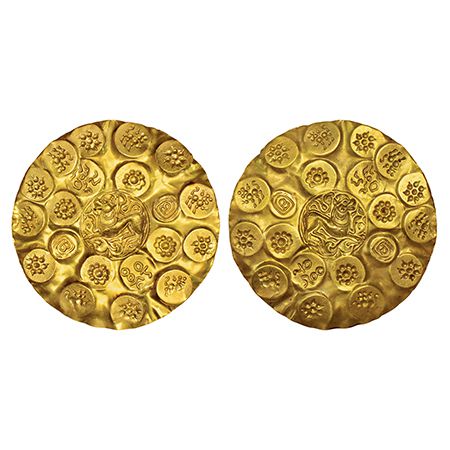
Kakatiyas of Warangal, Prola I (1052-1076 AD), gold punch-marked one-and-a-half Gadyana, 'Roaring Lion' type, 5.76g, Height: 57.26mm, Width: 57.78mm. Total of 21 repousse punches elegantly struck on the obverse of a broad circular thin flan in three concentric circular orbits which is broader than the usual PMCs. This coin has a unique combination of Lion and Lotus punch sequences. 1x the central punch shows a majestic roaring lion facing left with floral ornamentations around. The peripheral punches are struck in two layers, the first tier surrounding the central punch consists of 8 punches: 2x Kannada legend 'Sri', 1x Kannada legend 'Raaya gaja', 1x Kannada legend ' Kesari' and 4x nine-petalled flower symbol alternating between the legend punches. The outer tier consists of 12 punches: 6x Lion standing facing right with raised forepaw and 6x seven-petalled Lotus alternating with each other.
A fabulous specimen with a high relief strike and alluring surfaces, offering excellent eye appeal. Uncirculated, Very rare.
** You can enter any bid amount more than or equal to the Next Bid **
|
|
Lot No.115
AUC52
Hindu Coins of Medieval India
Gold
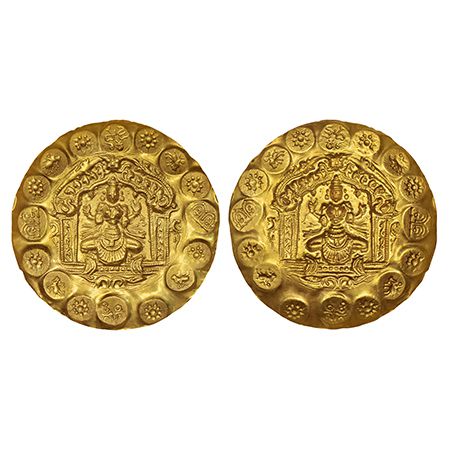
Kakatiyas of Warangal, Prola-II (1110-1158 AD), gold punch-marked two-and-a-half Gadyana, 'Goddess Lakshmi’ type, 9.74g, Height: 70.44mm, Width: 69.78mm. Total of 17 repousse punches elegantly struck on the obverse of a Padma shaped broad circular flan resembling a Lotus, symbol of wealth and prosperity. This coin has a unique combination of Lotus-Boar-Lotus punch sequences. The central punch shows Goddess Lakshmi seated in Padmasana, her draped saree elegantly spread below in the form of a lotus, within an arched Garbhagriha, the sanctum sanctorum, surmounted by a Kirtimukha at top and flanked by pillars topped with seated Hamsas. She holds two lotus flowers in her upper hands which are the symbols of beauty, prosperity and fertility. The lower two hands are in the abhaya mudra of divine protection and the varada mudra of granting boon. The outer peripheral orbit consists of 16 punches: 2x 'Sri-Sri', 1x 'Mandalika' and 1x 'Kesari' all inscribed in Kannada, and 4x group of Lotus-Boar-Lotus symbol alternating the legend punches. The boar is shown walking facing right with sun and moon above.
A superbly preserved specimen with gleaming surfaces, struck in high relief with brilliant details, offering outstanding eye appeal. Uncirculated, Extremely rare.
The Kakatiya dynasty succeeded the Nolamba dynasty and ruled for a brief period and their coins are extremely rare. Prola-II was a feudatory to the Chalukya Vikramaditya-VI and proclaimed independence with the decline of the Chalukyas. Prola-II extended his kingdom up to Krishna district.
** You can enter any bid amount more than or equal to the Next Bid **
|
|
Lot No.116
AUC52
Hindu Coins of Medieval India
Gold
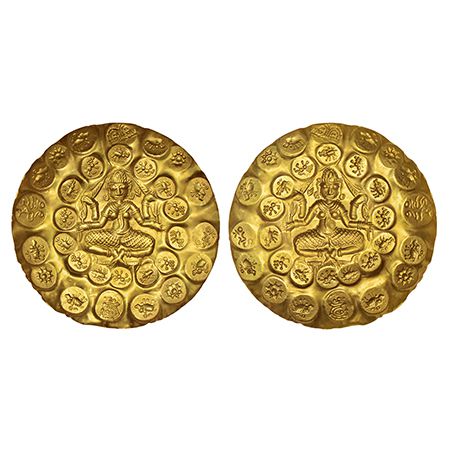
Kakatiyas of Warrangal, Prola-II (1110-1158 AD), gold punch-marked two-and-a-half Gadyana, 'War Goddess Durga' type, 9.76g, Height: 75.22mm, Width: 76.28mm. The broadest known Indian Hindu coin, unpublished variety. The obverse consists a total of 31 repousse punches elegantly struck on the obverse of a broad circular flan. This coin has a unique combination of Boar-Lotus-Boar punch sequences. The central punch depicts the War Goddess Durga seated in Baddha Konasana posture, holding dagger in her upper hands and a trident (trishula) and a mace in her lower hands, symbolizing Shakti, the universal divine power. The other punches are struck in two concentric circular orbits. The inner orbit consists of 14 punches arranged as if a garland of lion and boar pendants: 7x Lion facing right with raised forepaw and 7x Boar facing right with sun and moon above, alternating each other. The outer peripheral orbit consists of 16 punches: 2x Kannada letter 'Sri-Sri', 1x Kannada legend 'Mandalika', 1x Kannada legend 'Kesari' and 4x group of Boar-Lotus-Boar symbol alternating the legend punches. The boar is shown walking facing right with sun and moon above.
An exceptionally attractive and well-preserved specimen, struck on a remarkably broad flan with a bold, alluring strike and razor-sharp details, offering tremendous eye appeal. Uncirculated, Extremely rare.
The Kakatiya dynasty succeeded the Nolamba dynasty and ruled for a brief period and their coins are extremely rare. Prola-II was a feudatory to the Chalukya Vikramaditya-VI and proclaimed independence with the decline of the Chalukyas. Prola-II extended his kingdom up to Krishna district.
** You can enter any bid amount more than or equal to the Next Bid **
|
|
Lot No.117
AUC52
Hindu Coins of Medieval India
Silver
Shilaharas of Kolhapur, silver tara of Bhoja II (1175-1212 AD), 'Garuda' type, 0.25g. Obv: Anthropomorphic Garuda in 'Veera' posture, running to right holding a snake in his hand. Rev: Kannada letter 'Bha' and 'Ra'; crescent moon and sun above.
Extremely fine, Very scarce.
** You can enter any bid amount more than or equal to the Next Bid **
|
|
Lot No.118
AUC52
Hindu Coins of Medieval India
Gold
Yadavas of Devagiri, gold punch-marked Asu or 'Padma Tanka' of Mahadeva (1261-1270 AD), Similar to MSCI-I no. 288, 3.80g. Obv: Six punches: 2x Kannada letter 'Shri', 1x Sankha shell, 1x Lotus in centre, 1x Elephant & 1x Devanagari legend Mahadeva with a sword below.
Uncirculated, Very rare.
This coin has an additional punch of an elephant apart from the usual five punches.
** You can enter any bid amount more than or equal to the Next Bid **
|
|
Lot No.119
AUC52
Hindu Coins of Medieval India
Gold
Yadavas of Devagiri, gold punch-marked Asu or 'Padma Tanka' of Mahadeva (1261-1270 AD), Similar to MSCI-I no. 288, 3.82g. Obv: Six punches: 2x Kannada letter 'Shri', 1x Sankha shell, 1x Lotus in centre, 1x Boar to right & 1x Devanagari legend Mahadeva with a bow below.
Uncirculated, Very rare.
This coin has an additional punch of a boar and bow below the name of the king - both unusual features.
** You can enter any bid amount more than or equal to the Next Bid **
|
|
Lot No.120
AUC52
Hindu Coins of Medieval India
Silver
Yadavas of Devagiri - silver dramma of Mahadeva (1260-1270 AD), MCSI 290, 0.89g. Obv: roaring lion facing left with paw raised. Rev: Nagari legend Maha /(De)vah in two lines.
Good very fine, Rare.
** You can enter any bid amount more than or equal to the Next Bid **
|
|
Lot No.121
AUC52
Hindu Coins of Medieval India
Silver
Yadavas of Devagiri - silver ¼ dramma of Ramachandra (1272-1315 AD), not listed in MCSI, 0.23g. Obv: lion facing left with paw raised. Rev: Devanagari legend ...Rama /…vah in two lines.
Extremely fine, Very scarce.
** You can enter any bid amount more than or equal to the Next Bid **
|
|
Lot No.122
AUC52
Hindu Coins of Medieval India
Silver
Vijayanagar Kingdom - silver 10 taras of Harihara II (1377-1404 AD), 'Harmal hoard' type, MCSI 331, 1.81g. Obv: Devanagari legend Sri Hari. Rev: downward pointing sword separating sun and moon symbols; Nagari legend Hara below.
Good very fine, Scarce.
Coins of this type were first discovered in Harmal, Pedne Taluka, North Goa. They appear to be struck to a local standard current in Goa.
** You can enter any bid amount more than or equal to the Next Bid **
|
|
Lot No.123
AUC52
Hindu Coins of Medieval India
Gold
Vijayanagar Kingdom, Tuluva dynasty, gold pagoda of Krishna Devaraya (1509-1530 AD), Girijapathi 156, 3.34g. Obv: Balakrishna seated facing with conch shell at right and discus at left. Rev: Devanagari legend Sri Pra/tapa Krishna/raya in three lines.
A well-preserved specimen with a strong, bold strike, Extremely fine, Rare in this grade.
** You can enter any bid amount more than or equal to the Next Bid **
|
|
|
|
|